Showing posts with label hearing. Show all posts
Showing posts with label hearing. Show all posts
Thursday, January 30, 2014
Hearing Loss
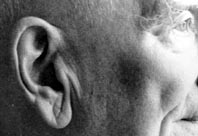 One in three Americans over the age of 60 have some degree of hearing loss. That figure jumps to 1 in 2 for those over 80.
For those with diabetes, the prevalence may be even higher.
An article that appeared in the Fall 2003 issue of Hearing Health explored the relationship between diabetes and hearing loss:
"Since vascular and nerve tissues play predominant roles in auditory function, any disease that has the capacity to damage their cells has potential to negatively affect the various hearing organs. A link between hearing and diabetes seems likely indeed if the rich blood supply to the cochlea and/or the nerve centers in the hearing pathways, including the brain, are affected."
The National Institute on Deafness and Other Communication Disorders (NIDCD) has an easy-to-read and comprehensive tutorial on hearing loss, including its causes, symptoms, treatment, and prevention. It recommends that if you answer "Yes" to three or more of the following questions, you have your hearing checked by a doctor.
- Do I have a problem hearing on the telephone?
- Do I have trouble hearing when there is noise in the background?
- Is it hard for me to follow a conversation when two or more people talk at once?
- Do I have to strain to understand a conversation?
- Do many people I talk to seem to mumble or not speak clearly?
- Do I misunderstand what others are saying and respond inappropriately?
- Do I often ask people to repeat themselves?
- Do I have trouble understanding the speech of women and children?
- Do people complain that I turn the TV volume up too high?
- Do I hear a ringing, roaring, or hissing sound a lot?
- Do some sounds seem too loud?
Finally, if youre having difficulty hearing, it may not be just a problem with your ears. Comprehension of what we hear takes place in the brain. As we age, the brain may lose some of its ability to filter out background noise.
Audiologists from the University of California, San Francisco, believe we can train our brain to recover listening skills - with or without a hearing aid. Theyve helped design an interactive software program with listening exercises that can be used on a personal computer. Free demonstration software is available at neurotone.com.*
For Hearing Health article:
Diabetes and Hearing Loss: Exploring Connections
For NIDCDs tutorial:
NIH Senior Health: Hearing Loss
For NeuroTones Listening Software
Listening & Communication Enhancement (LACE) Training System
* Not an endorsement. For information only.

Wednesday, September 18, 2013
Toys With Too Loud Noise Would Hurt Children Hearing Function
According to the latest research and test on the nineteen kinds of toys in the U.S market, after playing with 15 kinds of toys for about 15 minutes, children’s hearing function would get a little damage. All these toys designed for kids under three years old are with shake equipment or can be shaken.

Researchers from the American Visual Sense and Auditory Sense Association, one non-profit organization, and University of Minnesota, have tested the sound of all kinds of toys in the toys shopping mall. They would do the same thing each year and this year is the twelfth year. On the list of noise toys ranking, Iron Man Mobile Headquarters Vehicle, made by Jada Toys, is on the first position, the noise decibel sent out by it is as higher as 119.5 dB. In other words, it would injure kids’ hearing function in less than eight seconds. Learning Letters Mailbox, made by Fisher Price, are specially designed for kids between six months and 26 months, however, this kind of toys also make too loud noise, which is up to 113.9 dB. What you have to pay more attention is the books with music because it has reached up to 112.1 dB. All these toys on the list have too loud noise and could injure children’s hearing function in less than one minute.
Dr. Chris Hilton, the researcher from ear-nose-throat department in University of Minnesota has tested these toys and said that in a very close distance, playing with these toys for a long time would hurt people’s inner ears. In fact, the noise above 85 dB would have permanent damage to your ears. The louder the noise, the shorter time that resulting in hearing loss. For example, when hearing the sound with 85 dB, your hearing function would be damaged forever in eight hour while the hair cells would begin to get harm if you listen to sound with 100 dB for just 15 minute.
Because the arms of kids are too short so that toys with higher noise have more serious influence on their hearing function. Up to 2004, the U.S government had launched the regulations on toys’ sound. In March 2004, the American Society for Testing and Materials had adopted and amended the phonics standard, which is self-regulation in toys industry and obeyed voluntarily.
Different with asphyxia or other harm, it is difficult to estimate the hearing level on hearing function because it is difficult to determine the direct cause.
Article Source : Toys With Too Loud Noise Would Hurt Children Hearing Function
Author : TonyEva
Readmore...
Researchers from the American Visual Sense and Auditory Sense Association, one non-profit organization, and University of Minnesota, have tested the sound of all kinds of toys in the toys shopping mall. They would do the same thing each year and this year is the twelfth year. On the list of noise toys ranking, Iron Man Mobile Headquarters Vehicle, made by Jada Toys, is on the first position, the noise decibel sent out by it is as higher as 119.5 dB. In other words, it would injure kids’ hearing function in less than eight seconds. Learning Letters Mailbox, made by Fisher Price, are specially designed for kids between six months and 26 months, however, this kind of toys also make too loud noise, which is up to 113.9 dB. What you have to pay more attention is the books with music because it has reached up to 112.1 dB. All these toys on the list have too loud noise and could injure children’s hearing function in less than one minute.
Dr. Chris Hilton, the researcher from ear-nose-throat department in University of Minnesota has tested these toys and said that in a very close distance, playing with these toys for a long time would hurt people’s inner ears. In fact, the noise above 85 dB would have permanent damage to your ears. The louder the noise, the shorter time that resulting in hearing loss. For example, when hearing the sound with 85 dB, your hearing function would be damaged forever in eight hour while the hair cells would begin to get harm if you listen to sound with 100 dB for just 15 minute.
Because the arms of kids are too short so that toys with higher noise have more serious influence on their hearing function. Up to 2004, the U.S government had launched the regulations on toys’ sound. In March 2004, the American Society for Testing and Materials had adopted and amended the phonics standard, which is self-regulation in toys industry and obeyed voluntarily.
Different with asphyxia or other harm, it is difficult to estimate the hearing level on hearing function because it is difficult to determine the direct cause.
Authors Resource Box
Copyright by Tony Eva. EVToys Shop tends to focus on the high quality Kids Toys like Cheap Stuffed Bears, Wooden Toys, Cheap Stuffed Pandas http://www.evtoys.com/stuffed-animals/stuffed-pandas.html and so on. Products like Teddy Bear Couple with first-class service standards and first-class quality can all be found on EVToys.Article Source : Toys With Too Loud Noise Would Hurt Children Hearing Function
Author : TonyEva
Subscribe to:
Posts (Atom)